I haven’t written “deeply” in a long time. I used to write for pleasure, and I loved sharing thoughts and observations in this space. Recently, an itch to write again has been nagging me, and a few little voices have whispered that I should try and get back into it and that perhaps someone would like to hear what I have to say. I’m not too sure who wants to hear it, but I do know I want to scratch that itch.
The thing is, picking up writing again has been about as smooth as getting back on a surfboard. I’ve only ever surfed twice before, but the first time was great and I rode lots of waves and the second time I wiped out much more than I rode waves. Trying to find my voice in writing again has been a lot like that second time on the surf board. I’ve wiped out, I’ve gotten frustrated, but I WILL get back up.
When I learned to surf in Costa Rica, my instructor gave my board a shove as a wave came to give me a little extra momentum to catch it. I decided I needed to do the same for myself in my writing, so I did that the only way I know how.
I booked myself a day trip to Dover to write.
If we’re being completely honest here, I booked a trip to Dover to go to the beach, hike the White Cliffs, and get another dose of sunshine. But I chose Dover because I found out that I could take a slow train that takes almost 2.5 hours to get there, or a fast train that takes an hour, and I wanted to spend that time in the train writing.
Some of my best work has been on fast-moving machines.
Fast transportation casts a spell on me. I do my best work when captive in a high-speed machine, hurtling me towards a new destination. It might not be the eco-friendliest way of functioning, but I love intentionally booking myself long travel if only to spend time trapped in a train or plane.
There’s something both uninteresting and calming about watching the clouds float by outside the window, or the countryside whip past too fast to focus on any one thing. The scenery is just uninteresting enough that I don’t and can’t stay glued to it. It might be that my inability to focus on any one thing out the window for long forces me to instead to zoom in on whatever I have in front of me. I always feel quite pleased to be stuck in this limbo where time moves fast and stands still all at once.
Knowing that hours stretch before me calms me down. No one is waiting for me yet, there’s no rush; no hurry. I have a poor internet connection, if any at all, and a good reason not to check my phone or my emails. I pick my potion – the distraction that will keep my occupied for hours on end – and I settle in. My mind stops rushing around; it leaves behind the millions of things I haven’t done or need to remember later. I stop writing myself notes and setting reminders on my phone. The little device that constantly pushes me to multi-task disappears into my backpack or the overhead bin.
I pull my computer out to start typing or moving shapes on a PowerPoint, and I’m fully dialed in. The world stands still, and it’s just me and my Microsoft program. The creative muscles in my brain flex and I settle into an easy flow that I struggle to find when I’m static on solid ground. I settle into my journey’s distraction with ease.
But is that all it is? A distraction? Are the projects I’m working on just a distraction from the present I don’t want to be in anyway?
Perhaps I find peace in the idea that I’m both caught in a fleeting present, and hurtling towards a sure future.
I know what to expect.
Absurd as it sounds, when I travel in fast machines, I feel in control. It feels predictable, though I understand that there are any number of things that can happen (that’s predictable, too, if you will – but let’s debate that another time).
In a few hours’ time, I’ll arrive to a destination of my choosing. I may not recognize, nor seek to, the landscapes flying by my window. I may not finish the project I’m working on on the way there, but that’ll be okay because I’ll have run out of time. In any case, I’ll have accomplished something. I’ll have landed, made it through a journey, arrived at a destination, and that in and of itself feels like a small achievement. If I do nothing else in the day, I’ll have completed a journey. I can tick the box on my to-do list that says “travel from point A to point B.” Done.
That must say a lot about my personality; that I like to feel arrived. I need some sense of closure, some feeling of having accomplished something. The happy ending. I will look for items to tick off my to-do list if only to feel that my day was worth something.
But who was it that said that it’s not the destination, it’s the journey that matters?
Ah, yes. The age-old saying.
As I force myself into this journey v. destination debate, I have to wonder if I’ll look back on my life one day and feel proud of all the times I arrived. Will I be pleased with all the journeys that led me to my numerous destinations? Will the journeys have mattered?
I struggle to imagine an older version of myself looking back on my life and seeing only journeys without the destinations.
I can’t fathom looking back with satisfaction on the times that my Eurostar was delayed 6 hours. What will I think of the time I sat in a train for 7 hours, answering emails and finishing a project for work, only to return to London at the end of the trip thanks to a long line of frozen-over tracks on the other side of Calais? Even as I think back on it now, I couldn’t tell you which work project I was finishing; I couldn’t even say whose emails I replied to.
In truth, they probably weren’t that significant. I might’ve given my two cents on a research proposal; might’ve shared my thoughts on the ideal audience segmentation for a study we’d like to run so we can share some strong thought leadership on a topic a prospect is interested in. But really, all I remember is not arriving. I remember feeling frustrated to have sat in a train for 7 hours only to go back home, sleep 4 hours, and wake up early the next morning to try to get on the next Eurostar. I do remember arriving. I made it back to Paris just in time to catch my next train to Deauville, a trip for my best friend’s birthday that I didn’t want to miss, and that was significant.
But then again, perhaps the journey reveals more than I give it credit for.
Fine I said it. I feel accomplished when I arrive at a destination, but the journey isn’t always insignificant.
Today, as I traveled to Dover to hike the cliffs, I realized upon arrival that I had arrived, but that I actually didn’t plan my trip at all. I had no idea what to do first once I got there. Hike the cliffs was about all I had on my itinerary, and I had imagined unkempt dirt trails and myself hiking alone on tiny paths along the cliffs.
I probably should’ve realized that, given that it’s Memorial Day weekend and I was traveling to a town best-known for it’s important role in WWII, there’d be tourists everywhere. Almost miraculously, that just didn’t occur to me right away. All I knew was I wanted a beach, some nice scenery, and something outside, far enough away from London that I’d be stuck on the train for a while, but close enough that I could manage a day-trip. Hiking around the white-rock cliffs in Dover didn’t necessarily seem like the first thing everyone would run to do on a bank holiday weekend.
Oh, but it was…
I should’ve gotten an inkling that my solo trip would be less than serene the moment I stepped onto the train.
I had imagined a somewhat vacant train; I had even gone so far as to book the “Super Off Peak” ticket. I figured I’d have empty seats all around me and my pick of window seats… Wrong. I could scarcely find a free seat when I got on the train. After I snagged mine, it was quickly standing room only.
When I got to Dover, I fumbled around with my map for a bit and finally decided to start by hiking to the castle. After all, it was in a big swath of green on my map (natural park, right?) and seemed to have hiking trails around it, based on the small white lines running around it.
Upon arrival, I was surprised at the £24 entry-fee. The surprises only got ruder as I wandered through the WWII memorial areas, packed with heavy-set, middle-aged men in WWII uniforms playing camp and pretending not to notice the throngs of tourists, most of whom were families with small children. And yes, they were crying. I really hadn’t bargained for walking in slow moving lines behind every young family on this side of England, and was quickly frustrated by the experience, but thought, I’ve already paid, I might as well go look at this snazzy castle and the fancy cliff tunnels.
I did the castle first. Walking up the winding steps to the top of the Great Tower took a lifetime. When I came back down, almost 45 minutes later, I was already audibly grumbling under my breath, whose idea was it to do a WWII day… Great, tunnels?! Who even needs to see a tunnel? I know what a tunnel looks like…”
I stopped in my tracks and thought a minute. I didn’t come here for this. I came to hike. I came to look at beautiful cliffs and be in nature, ALONE. I don’t care how much the entry fee was, there is absolutely no reason I should feel obligated to stay here.
So, I left.
I was so fed up with other tourists by then that as I started walking down the hiking trails towards the White Cliffs of Dover lookout point, I found myself internally grumbling again as soon as I got stuck behind a slow-moving group. The rational side of my brain encouraged my emotional side to be positive, to take in the views, to enjoy the destination… Emotional side wasn’t having it.
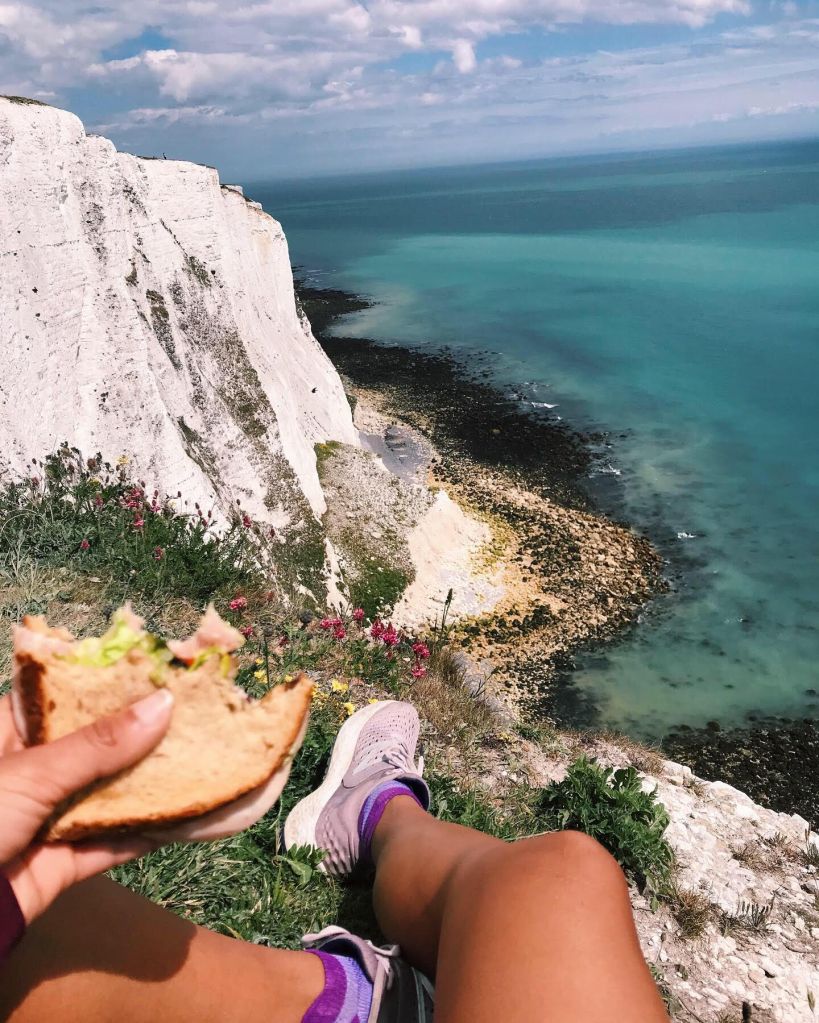
I finally stopped for lunch and ate the sandwich I’d packed on the edge of one of the cliffs, overlooking the beautiful White Cliffs of Dover. The view was incredible. A stark white cliff sat against clear blue water that tossed its gentle waves against brown, algae-covered rocks below, as chalky white and gray rocks sunbathed on the beach. Tourists plunked themselves next to me one-by-one, not really taking in the cliff itself, but snapping pictures, first of the cliff, then of themselves in front of the cliff, and then moving on. As I finished my sandwich, a very opportune group walked up to me, tapped me on the shoulder and showed me a couple pictures they’d taken of me eating (nice), and then offered to send me the pictures. I smiled, half embarrassed half flattered, and accepted them. Very unceremoniously, in return, they asked me to vacate my spot so that they could take their own pictures. As they pointed to my seat, my jaw loosened on the clementine I was chewing. I looked side to side at ALLLL the cliff they could go sit on to take a picture, and felt a mix between a tight-lipped, fake-polite smile and an eye roll making their way to my face to replace the friendlier smile that had been there before.
I caught myself and nodded instead. I put my clementine peel in my backpack, stood up, thanked them for the pictures they’d sent me, and walked off.
Despite being a tourist myself, I was so fed up with the tourist shenanigans that I hiked right past the lighthouse I had initially told myself I’d stop at. From the path, I could already see that the outside tables were far too busy for my taste. Instead, I dove down another dirt and pebble path that led further down the cliffs, between farms and houses. Almost immediately, as I walked away from the tourist-infested lighthouse, something shifted.
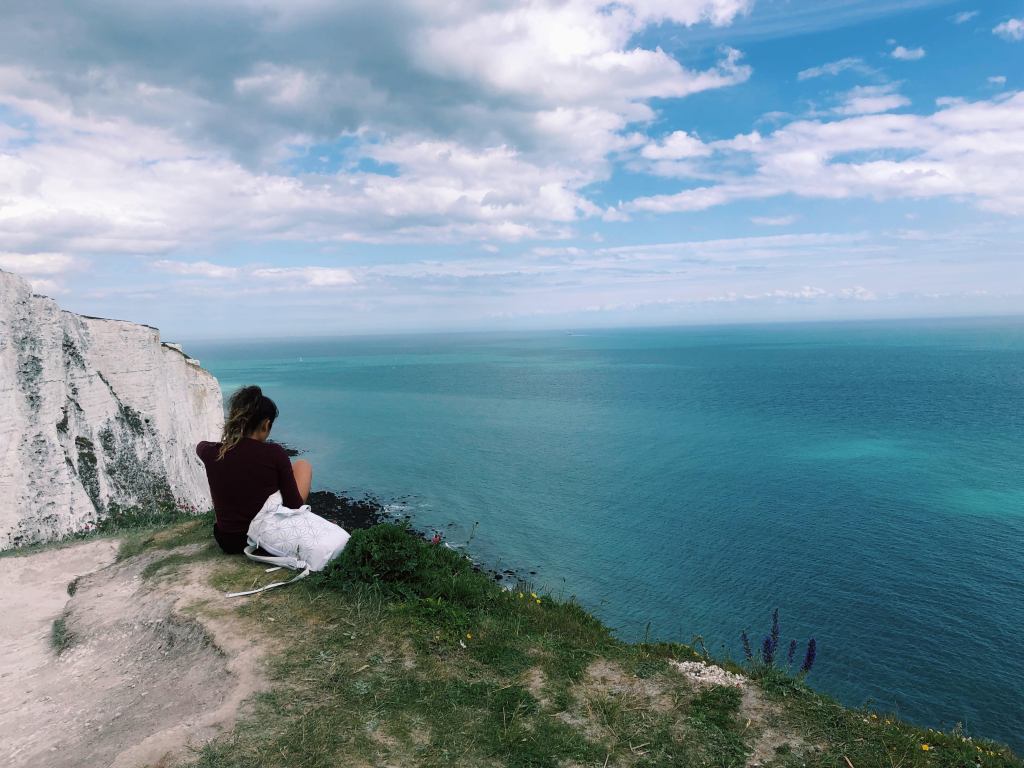
Once on my own, things started looking up.
The paths widened. Nobody was around; I had plenty of space to myself and could walk at my own pace without rushing anybody else along. A canopy of green leaves and a few cows were my only companions, and I suddenly felt blissfully far from the tourist haunts. The solitude did me so much good that I felt inclined to smile at the rare person I did cross paths with.
The path turned to a road with houses along it, and I thought about turning back, realizing that I’d hiked clear into the neighboring town. As I began to turn around, a sign that read “Beach Path” caught my eye. Okay, I thought, just a little further, why not?
Not five minutes later, I heard live music and the sound of waves. As I walked out of the trees and turned a corner, a big open beach with only a small sprinkling of people on it stretched before me. White cliffs surrounded the open sand-and-pebble beach on either side, and I dashed over to one of them to get a closer look.
As I began to walk down the beach, I saw the rocks covered in algae and the chalky white and gray pebbles up close. I hopped from one big rock to another and felt a playfulness I might’ve hidden around other people bubble up inside of me. I ran, leapt and crawled over the rocks, the beach my playground. I dipped a toe in the water and played chicken with the waves, leaving my discarded socks dangerously close to the rising tide. It was the nirvana moment I’d been hoping for in my solo trip, and I was reminded of how blissful it had been when I ran down the empty beaches in Costa Rica.
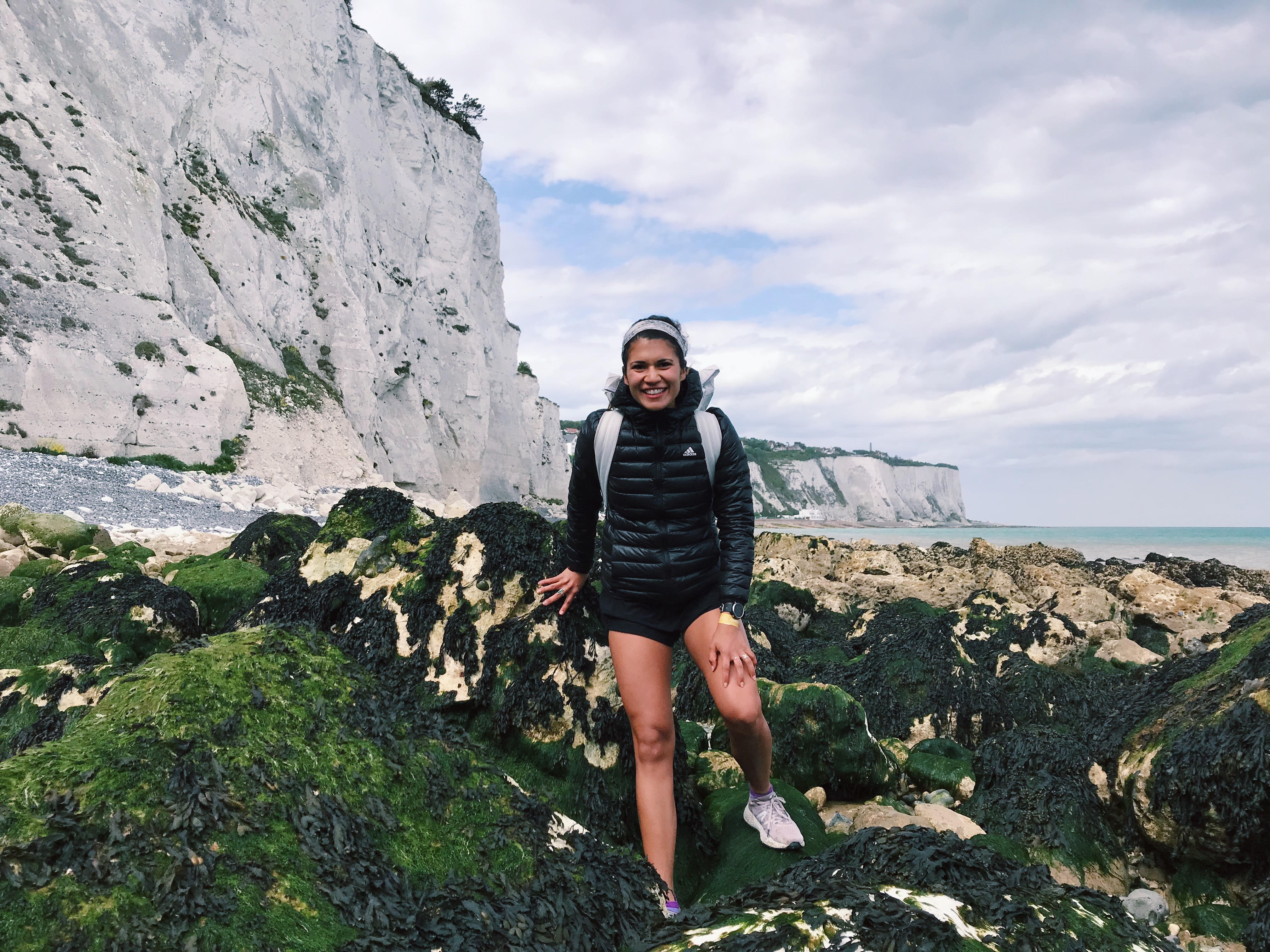
Had I planned ahead for my trip to Dover, I might never have found that empty bit of beach. The speck of beach wouldn’t even have shown up on Google maps, and I probably would’ve thought a 15-mile round-trip hike seemed like a bit much for one afternoon. In the end, though, I’m glad I hated the tourist areas; relieved that I wasn’t content with the 4-mile loop and opted for a lengthier walk.
So, is it the journey or the destination that counts?
I would argue it’s neither.
It’s all the distractions along the way. It’s the tiny moments where we let our control slip, for just a second, and something incredible comes of it. Maybe we know where we want to wind up. We might have a plan for how to get there and what we’ll do on the way, but, try as we might, we just can’t control it all. We can’t plan for serendipity or build a memory in advance.
When I began thinking on what to write about on my way to Dover, I had decided ahead of time that it’d be Budapest. I was going to use my time in the train today to detail my trip there; the place I stayed, the incredible restaurants and baths and beautiful sites visited, and share advice on how to plan a killer trip to the city. I did try to write that story, but I couldn’t do it. The little muse that runs my brain when I’m not looking wasn’t interested in that today. Instead, we wondered why I was writing in the train in the first place and wound up talking about journeys and destinations in the end.
In the end, even the journey doesn’t always go as planned.
I can prime myself for deep work in the train or the plane. I can set aside the distraction of my choosing well in advance. I know where I’m going, and what box I want to tick at the end of the day. I know how to fulfill the controlling part of me that loves lists and accomplishments and praise and wants to pat herself on the back.
I also know that I probably won’t remember that list. My to-dos are probably the most insignificant thing I will set aside for myself today, and, yes, tomorrow, too. When I look back on my life one day, I doubt I will remember all the small tasks I accomplished.
What I may remember are the moments that marked me. The moment got sick of the tourists and found a special beach. The moments I spent alone in what might’ve been one of the most heavily touristed parts of England over the bank holiday. The moment I let this piece be about today, and about distractions and journeys and destinations, instead of a trip I’ve already gone on.
I will remember what I didn’t plan. The rest might just be nice, superfluous detail.
xx
Kate
P.s. I had to cut this piece a lot, and I probably should’ve similarly cut down other recent posts. I haven’t written as often or as fluidly as I used to in a long time; to say over a year would not be exaggerated. I’m getting back into it, but I’m finding I have to write a lot of garbage before I realize I have something more important to say, and I have to sift through a lot of junk before I find anything worth hanging onto. Bear with me as I ramp back up again. There will likely be junk, but I hope there will be something interesting, too. Regardless, I plan to make this a more regular thing and I hope you’ll stick around. See you soon?
 The Transition Artist
Quel plaisir de te lire de nouveau Kate ! 🙂 Ce sujet me touche aussi personnellement, et je me suis complètement retrouvée dans tes écrits. J’adore travailler dans le train ou l’avion, ce sont les 2 endroits ou je suis la plus efficace.
Très bon développement en tout cas, et surtout continue d’écrire, j’aime beaucoup ta plume 😛 tu me motives même à reprendre un blog, peut-être plus tourné sur l’écriture que sur la photographie.