I ran my first marathon on April 14 in 4 hours and 13 minutes. I crossed the finish line and burst into tears of joy; I’ve never felt so proud of an accomplishment.
Perhaps some people wake up one morning and get the inkling that a marathon might be a fun idea, some might get peer pressured into it by friends, and some just sign up on a whim. I have a lot of respect for those optimistic, strong willed people, but I am not one of them. The marathon was a very calculated choice for me, one that I’m not sure I ever really chose, but grew a sense of attachment and obligation to.
I have wanted to run a marathon for as long as I can remember.
You see, I grew up around marathons. I have an inspiring role model for a mother, and she’s run 8 of them over the years. She spaced them out over just enough time that I remember almost every single occasion that I found myself cheering her on from the side of the road, or at home poring over the TV in the hopes of spotting her in the crowd.
I watched my mom fight and grind her way through the races, and I stood by as her proud cheerleader. I colored poster boards to read, “Go Mom!” and excitedly took my place on the side lines, sticking out my little hand to high five all the runners while I waited for her to pass, screaming my lungs out cheering. I watched hordes of people pass by, but none was quite as radiant as my mom the superstar was.
Though I knew that to live those moments of “fame” and glory she had to put in hours and hours of training and hard work, I only rarely saw her enduring the training. She woke up at 3 or 4am, long before my alarm went off, and cranked out her training runs alone in the dark. When I was old enough to trot alongside her, maybe around 8 years old, she would loop back to the house on a Sunday morning at the end of a long run and pick me up to jog her last mile with her. On those runs, she taught me good form, how to swing my arms, and how to breathe properly while running. Those were our bonding moments; we talked about my school drama, told each other stories, and encouraged each other along. The more we jogged together, the more I fell as madly in love with running as she was.
I started running track and cross-country when I was in middle school. I was a pretty average runner, and only managed to place in the top 20 once in a blue moon. I wasn’t one of those gifted kids who naturally runs faster than all the others, but I willing to stay optimistic, work harder, and train longer than a lot of the other kids, so my coaches continued to push me, and year after year, I kept coming back, all the way through high school.
My mom subscribed to Runner’s World magazine and I read it religiously. I devoured all the editorials about top long distance runners; my role models included Paula Radcliffe, Shalane Flanagan, Kara Goucher and Meb Keflezighi. Outside the running world, these world champion marathoners might not be well known, but that was exactly what I admired about them; they are strong, humble warriors, who have dedicated their lives to beating themselves (their own personal records that is).
Though nowhere near as fast or gifted as they are, I like to think my own path has been much like theirs. I push myself hard to continually work towards a better version of myself. I have always been harder on myself than my coaches ever could be, but it infuriated them that the only person I truly cared about beating in a race was my past self; I never really cared what place I came in as long as my times were better.
It may be for this exact reason that I preferred cross-country to track and field. I loved the moment in the race where we disappeared into the woods and suddenly the cheering subsided and the only sound was breathing and footsteps. I no longer had a coach in my ear yelling to pass the girl next to me, or parents yelling at their kids to pick off a runner who was “already tired”; it was just me, my thoughts and my legs propelling me forward, and in those moments I suddenly felt stronger than ever and light as a feather, like I was flying.
My senior year of high school, I ended my stint in team running as captain of the cross-country team. I decided my love of beating myself was more important to me than tough competition and having lots of eyes on me as I ran round and round a track, so I quit track and field before the season started and signed up for a half marathon. My mom helped me train for the Dallas White Rock half marathon, and the two of us ran it together, holding hands and tearing up as we crossed the finish line. It was the furthest I had ever run, and I felt an immense sense of accomplishment.
I went on to run a few more half marathons over the years that followed, and once I felt I knew that race well, I set my sights more clearly on the full marathon.
I trained for my first marathon in 2014. Two months in, my left knee was killing me. Having grown up running, I thought I could handle anything, but I had increased my load too quickly, over-trained and landed in a sports medicine clinic for the first time in my life. I had IT band syndrome, something I’ve struggled with ever since, which meant the lateral muscle running from my glutes to just below my knees was working too hard and had tightened and filled lactic acid, making it excruciatingly painful to run, much less walk and go and down stairs. I spent the following months leading up to the race in physical therapy, getting steroid injections in my knee, doing strengthening exercises and running on anti-gravity treadmills to try and keep my mileage up, but didn’t heal fast enough and had to sacrifice my race.
In 2016, I decided to give the marathon another go. I signed up for the Green Europe Marathon, a course that runs down the coast of Slovenia into Italy, finishing in the small Italian town of Trieste. I was so excited, and was cautious so as not to make the same careless training mistakes I had made in 2014. I foam rolled, did reinforcement exercises, and trained carefully, respecting my body. I completed the 4-month training and started tapering ahead of race day. In Europe, and Italy in particular, there are very strict rules around races, and I needed to get a medical certificate signed by a doctor that verified that I was fit to run. I’ve always been fit to run, so I wasn’t worried about it and went to see a doctor two days before race day.
The doctor put a stethoscope first to my back and listened to my lungs. Healthy. Then, he placed the stethoscope on my chest and listened to my heart. He paused. He moved the stethoscope around a bit and paused again. “Strange,” he said. One word. Strange? He asked me to lean forward and listened again. He said he was hearing a whooshing sound, and asked me to follow him downstairs for an EKG. After running the test, he printed out my EKG recordings and showed me the lines of my heart beat. He pointed to a small down curve on the EKG reading and said, “On a normal, healthy person, this wave goes up. Yours goes down. I believe that the whooshing sound I was hearing through the stethoscope is a heart murmur. If you have a heart murmur, your heart pumps out more blood than it takes in, and without doing further tests, I can’t sign your medical certificate.”
That day marked the beginning of a long road for me.
For the first time in my life, I was told that I couldn’t run, not because I had any injuries or illnesses, not even because anything was visibly wrong with me; I simply couldn’t run because “I might not be made for it,” and that was unfathomable to me.
This news marked a low point in my running journey. I cried a lot on and off, cancelled my trip to Italy, cancelled my hotel, and grieved my second failed attempt at the marathon. I was advised to avoid high intensity exercise and to get an MRI, and told that it might be a good idea to stop running for a while. I felt lost and confused, betrayed by my body, and angry with the doctor, though I knew it wasn’t his fault. I was so disgusted that I distracted myself with other activities, gave up on the idea of a marathon for a while, and put off the tests, worried at what the outcome might be.
In 2018, my curiosity got the best of me, and I scheduled an appointment with a cardiologist. I missed training for something and having an objective on the horizon, and I needed to know what I was capable of. I got an echo-cardiogram, an MRI, did stress tests, and had a lot of long “what if” conversations with my cardiologist. I told him about the marathon I dreamed of running, and asked him if there was any possibility of getting cleared for it. He explained the different types of heart murmurs, the risks of long distance running (i.e. dropping dead), and said he could make no promises but would give me a definitive answer at the end of my tests. He needed to check the thickness of my left ventricle. If it measured more than 11mm, it would be impossible to clear me for long distance or competitive running, and he would diagnose me with hypertrophic cardiomyopathy, in which the heart pumps blood less effectively. Under that, I might be okay.
On the day of the MRI, my stomach was in knots. They injected a concoction to dilate my blood vessels and speed up my heart, mimicking the effect of physical activity, and I sat in the machine and practiced deep breathing exercises, trying to calm my nerves. When it was over, I was sent back to the waiting room for the cardiologist to analyze my results. Less than 15 minutes later, he came out smiling. My heart fluttered and my anxiety rose. “Well?!” I said.
He pulled out a few images he had printed from the MRI and handed me a CD. He pointed to the images and explained that the ventricle he was checking measured 7.5mm. It was thicker than normal, but not concerning. “Bring your medical certificate to our next appointment,” he said. “I’ll sign it.”
I was granted the gift of competitive running on the condition that I would come back to see my cardiologist once a year for a new EKG and stress test. My medical certificates only last one year; one guaranteed year of doing what I love, that could always be my last. My left ventricle will likely continue to thicken, and when and as it does, I may one day no longer to be able to run competitively. Right now, though, I can, so with my certificate in hand, I signed up to run a half marathon in March, only 6 weeks later. It didn’t matter to me that I didn’t have much time to train, I was just excited to train again.
In April, as soon as registration for the Paris Marathon opened, I signed up, knowing that my participation would be contingent on the results of the same tests to be conducted the following year. That was fine. I decided that if the third time wasn’t the charm, then it wasn’t meant to be.
In May, I had an accident.
I had just moved to London and joined a new gym. I was in peak form, running a 10K every two days, going for 8-10 mile runs on the weekends. I was unstoppable. I was fit, settling into a new life in a new city, had an exciting new job, had been cleared for high intensity exercise, and had even established a regular meditation practice and was coping well with big changes. Nothing could possibly go wrong!
Until it did. On the morning of May 21, I went for a swim at my new gym. I swam for 20 minutes, and then practiced some deep breathing exercises that I had learned to prepare me for challenges; they had become a regular part of my meditation practice. I took 40 deep breaths, exhaled all the air from my lungs, and then closed my eyes held my breath until I felt my lungs call for air. The practice comes from yogic pranayama breathing exercises. They work great on land; not so great in the water.
I held my breath under water one beat too long, and instead of coming up for air, passed out and began to drown. I stayed under water for 2 minutes and 55 seconds, according to footage from the CCTV at the gym. Lucky for me, other swimmers took notice and jumped to pull my limp body out of the pool, and, luckier still, a bystander performed CPR while another hit a panic button that summoned emergency services. I died that day. I was brought back to life by a group of strangers. They are the only reason I am still alive.
I was coherent and talking again by the time they wheeled me into the ambulance. Five minutes earlier, I couldn’t speak or say my name, but now wanted to sit up and talk, pulling the oxygen from my face and demanding my belongings from my locker, the number of which I now remembered. I felt fine and thought I’d be released later that day. It was a fluke accident, and I was embarrassed more than anything else. I asked the paramedics to call my office and let them know I wouldn’t make my 9am meeting, and told them not to bother calling my parents; it was the middle of the night in the States and I didn’t want to wake them, I’d call them later.
Because of my heart condition, I spent five days in the hospital after my accident. The doctors couldn’t agree on the exact reasons I had passed out, nor the exact sequence of events, and they wanted to monitor me for an undetermined amount of time. They kept me in the “acute care” unit, where most emergency patients are received before being placed elsewhere. The noisy, chaotic environment was a living hell for me. The days felt long and expansive. I was awoken every four hours of the night and asked rapid fire questions about my age, my name, and where I was (which no normal person can answer coherently when woken up at 4am anyway), and I watched silently as a revolving door of bed-mates were placed next to me at all hours, feeling out of place next to wailing patients suffering from suicide attempts, strokes, and third degree burns, among other maladies.
An endless rotation of doctors and nurses passed by my bed, day and night, and, as they passed each other my file, a game of telephone began. I listened to them tell each other one-by-one a different version of the same story without asking for my input.
“She’s very weak. She collapsed in a pool due to a heart condition,” one would tell another, much to my dismay.
“It was actually because of breathing exercises,” I’d correct. No one ever really listened to me, they’d just nod vaguely and keep telling their version of my story. They found fancy, technical ways of telling each other that I had died and been brought back to life, talking about me as if I wasn’t there, and then periodically someone would come by to check on me and remind me “how lucky I was.” But as I lie chained to a heart monitor wearing nothing but an uncomfortably revealing hospital gown and listening to doctors tell each other that I was weak and vulnerable, I didn’t feel very lucky. I realize now, looking back on my circumstances, that I was insensitive to my own situation, and in some ways still am, because I felt very much removed from it, as though I was watching someone else. I couldn’t fully understand why I wasn’t allowed to return home after 24 hours, and I was frustrated that nobody ever explained what was happening or gave me any sort of diagnosis or medical opinion. I was more functional than any other patient in the ward; up wandering around, walking, talking, and reading the same day I’d had my accident. By day two, I had even learned how to properly unhook and reattach myself to my heart monitor so I could stop calling the nurse any time I needed to get up to go to the bathroom.
When I was finally released, I was sent home in the set of pyjamas that I had negotiated leaving the hospital to go purchase so I could stop wearing gowns without underwear. Upon discharge, I asked if there was anything I should know or any necessary follow-ups. The doctors still hadn’t come to any conclusions, but had no reason to keep me around anymore, so the only advice they gave me when I left was, “take it easy. Don’t do any hard exercise.” Having already mentally moved on, I told them that I had a marathon on the horizon and wanted to start running again. They laughed and said, “There won’t be any marathons for you.”
Even as I write those words, I still harbor a lot of resentment towards those doctors, though I understand why they found my asking about running so soon humorous. The only issue was that I didn’t know when I’d see them again and I needed answers. They were the first to say, as they told me how lucky I am, that I never would have survived my accident had I not been as physically fit and healthy as I am, but when it came to getting back to my normal activity, they sneered, laughed, and advised against it without running a single stress test. As a result, they wouldn’t sign a health certificate to allow me to return to the gym. I was forced to leave the gym and wait for a follow-up appointment with a new cardiologist in October, a full 5 months later, simply because he had no available appointments until that time. I was angry; angry because they doubted me, angry because they didn’t take the time to examine me, and angry because they didn’t care about my getting back to normal, in their minds, alive was good enough.
Alive was good, but I wanted to start living again.
I started running again later that year, after a long break. Despite my bitterness at losing my medical certificate, I felt happy, lucky, and excited to be alive. Runs felt more invigorating and, in the moments I felt like I was flying, my eyes filled with tears of gratitude; something that still happens to me to this day. Each longer run felt like a victory. Every challenging workout completed added another point to my mental “I knew I could” bucket. I wasn’t going to stop living just because I had died; I was determined to live an even richer and fuller life, if anything.
By the time I saw the cardiologist the hospital recommended me to, my accident felt light years away. He performed a stress test and all the usual hoopla. I tested as well as usual and, smiling, said, “so you can sign off on a medical certificate then, right?”
“I’m afraid not,” he said. On precaution, he explained, though my heart was not yet thick enough to diagnose me with hypertrophic cardiomyopathy, he had decided that my accident was proof enough that the diagnosis fit and that my condition was advanced enough that he would advise against my continuing intense physical activity. I left the appointment in shock. I cried and cursed him on my way home, and went for a run the next day anyway in spite of him, convinced I know my body better than he ever could, though his opinion left a heavy cloud of doubt hanging over me.
I decided to get a second opinion. The second opinion, uninfluenced by the game of telephone, came to a different conclusion. After repeating all the tests, I was cleared for competitive exercise once again.
The easy solution would have been to give up running.
I could have listened to the conservative doctor, and I could even have used my accident as an excuse for falling into an easier, more relaxed lifestyle. But I didn’t want that; I didn’t need an excuse for easy. Giving up running at such a pivotal time, when I was questioning my own strength and was suddenly described as “lucky” instead of “determined”, felt like it would be the tipping point in an identity crisis. I had a big goal to reach, and I wanted to prove to everyone, but most importantly to myself, that I could make it happen. I may have to give up competitive running one day, but not today.
When I got a second opinion from a different cardiologist, I got the confidence boost I needed. “You are in great shape,” he told me. “You have the physical conditioning of a professional athlete, and, as far as I can see, exercise does you more good than harm. I have no reason not to let you continue.” I felt overcome with a wave of relief. For the first time in 9 months, my accident didn’t define me or my ability. A medical professional believed in me and my capacity to overcome my past self and circumstances. He gave me the confidence (and the medical certificate) I needed to finally put my head down and work towards the thing I have wanted most for years, so I did.
On April 14th, I finished what I started.
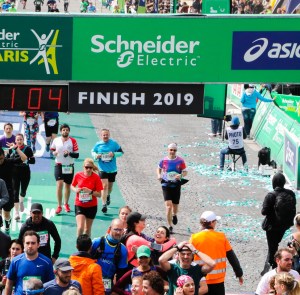
In one of the most emotional and exciting experiences of my life, I completed my first marathon. Throughout the race, my mind played a soundtrack that has become very familiar to me now:
“I can do this. Thank you, Lord, for a heart that beats, lungs that breathe, eyes that see, and legs that turn. I can do this. Help me do this.”
It was long, at times painful, and both mentally and physically taxing, but I loved every single second of it, from the easy comfortable first few miles to the gut wrenching, excruciating last six. Finishing that race took me three attempts, a near death experience, and a lot of rebuilding of confidence, strength, and mental toughness, but I have never wanted something quite so badly, never overcome quite so many obstacles, and never felt prouder of myself for making it to a finish line.
This is a very public way of sharing a humble warrior’s story. However, I share this here for a very specific reason. I realize that my life since the accident has revolved around me, and I’m ready to move onto a new chapter, but don’t feel I can without closing the last by writing out its story. For the past year, my world has revolved around making my own life better and doing everything I can to prove to myself that I’m very much alive and stronger than ever.
I have faith in my strength now, and would like to use it for someone else’s benefit.
I’ve signed up to run the Chicago Marathon on October 13, 2019, and this time, instead of running for myself, I’m running for charity.
So I end this story with an ask: join me by supporting Mercy Home to help kids from environments marked by neglect, abuse, and despair. Please donate to my marathon page to help youth heal and grow, get support for school and the tools they need to build a successful and self-reliant future.
 The Transition Artist
Kate- it certainly has been a journey! Though scary at times, I knew you would persevere. A life well lived is not without occasional risks. I never doubted your resilience to accomplish your goal and was your tireless cheerleader & coach to share the lessons I learned in my own marathon journey. Each challenge we have in life teaches us something about who we are and what we’re made of. I know having been thru all we’ve been through together, you take nothing for granted and know you will live each day to wring all the life out of it! I thank God each day for the blessing of you. And, am so thankful for each moment & memory we have shared together and those yet to come! Love you! Mom
Kate! I never knew all this about you! It helps me understand why running a marathon is so important to you. Cheers and you go, Girl! So happy for you crossing the finish line in Paris! On to Chicago!!