 I live in a world where it is normal to breathe in all the people who happen to be headed the same direction as I am on my way to work. For an hour, I am pressed against strangers. Arms I don’t know rest on my head to hang on to the pole that steadies the bodies around me. Strangers hands graze my backside and arms and sides, and mine graze theirs as I try to readjust my bag or turn a page on the book I hold too close to my face, so as not to rest it on the shoulders of my neighbor. I keep one arm locked to the central pole, another clasping the iPad I use to read. Otherwise, I am lodged in a sea of tightly packed bodies.
I prepare myself for my hour long commute like a soldier going to battle. I carefully fold up my emotions and tuck them away, refusing the irritation and frustration. I arm myself with headphones, creating a bubble of music around myself that allows me to forget the proximity of my ears to the nearest lips. My bubble closes out the exasperation and frustration of those who forgot that these circumstances are inevitable, those who curse and reproach the other sardines that happen to get too close in this vacuum sealed can. I close in on the downloaded book on my iPad, adjusting the font so I can read it comfortably at close range, and I leave the world around me and enter another. I like to call this a good use of my time, but it’s also a coping mechanism. At the beginning, I used to try to position myself close to the windows. I wanted to lose myself in the sky and the sunshine, safely tucked inside my musical insulation, but I quickly realized that the doors and windows were the front lines, and became exhausted by the exercise of constantly craning on my tiptoes to get one last glimpse at the sun before some taller person blocked my view.
Now, away from the windows and finding my way into the world my book brings along, I still feel the eyes around me. The unoccupied persons who are so aware of my presence wouldn’t meet my gaze even if I looked up into theirs. Despite our closeness, we are very separate. I allow myself to enter this world and share in it tentatively every now and then when it feels safe.
I gather small bits of information about the people around me, just enough to dip a toe in these deep waters without getting overwhelmed. The woman to my left is a smoker. She likely indulged in a cigarette just minutes before the depart of the train, preparing herself for the haul. The hair and grisly breath on the man next to me tells me he rolled out of bed and got dressed without showering or having breakfast this morning. The girl behind me in the light pink jacket is an old veteran, she’s been commuting for a while; she smiles kindly and forgives me for bumping her and resting some of my weight on her small frame so I can make room for other passengers to exit, she understands. The man in front of me works in finance; he looks late, is overly coiffed in his suit, and bathed in his cologned.
This space is so different from others that I have inhabited. I both detest the proximity and force myself to steep in it and acknowledge the other human beings that surround me. While there are areas in my life that feel more lovely lived slowly, this is not one. For the third time this week, the train sits at a standstill as motionless as its passengers, blocked at stops still miles outside of the city, and I watch the time roll by and keep breathing as I calculate exactly how late I’m going to be to work on this particular day.
Despite the dread this commute inspires in me twice a day, I am grateful to live at a distance from the city. I am thankful that, on a daily basis, I see the difference between being too many, too close, too long and the free, fluid movement of beings in natural space.
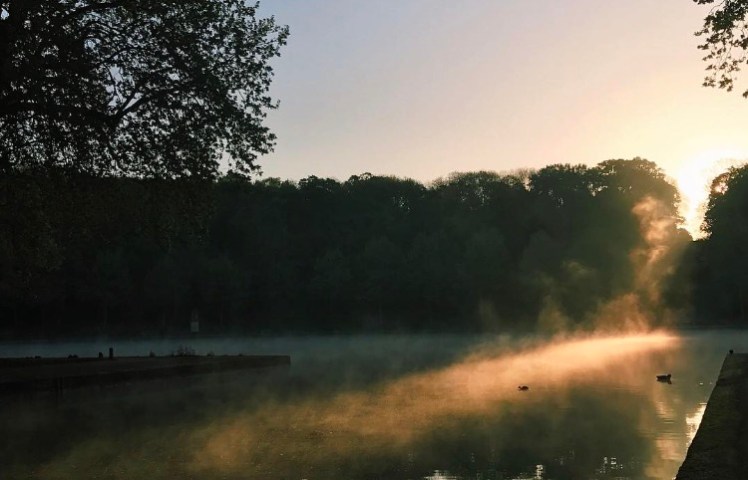
In the morning I like to run at the park by my apartment. Thanks to the summer hours, it now opens at 7, and I leave home at 6:50 to be one of its first visitors. There are only a few of us at that time, maybe five to ten in total, with miles of space all to ourselves. That small space of time in my day is one of the most peaceful. There, I don’t hear the cars and motorcycles and sirens. I don’t hear people and bus chimes and metro buzzers. There, it’s just birds and ducks and me, and a few other human beings. There’s fog lifting off water with brilliant beams of sunshine as it peeks over the trees. There’s chirping and breathing and dirt crunching under feet. The air feels freer; more plentiful and refreshing. It is in this space that the other people and I become humans again.
We have enough space to be alone, and smile at one another as we pass, something we wouldn’t do in the metro or on the street, pleased to share this small moment of endorphins, heavy breathing, and sunshine with someone else for a split second, and content to continue in it on our own. Here, we are different people, these runners and I, up early for a jog at sunrise. We are city dwellers that have not yet turned off their humanity; for a moment, we fight for it. We wake up early and put on our shoes and reconnect with our movements, contrary to the robotic shuffle of feet of the commuters who forget what it is anymore to move leisurely. We exit our busy lives in the morning and make ourselves move, for the sole purpose of moving. Given the space to see, suddenly we see each other.
So now, in my train, I don’t shut down completely. The unusual smiles of others don’t go unnoticed, and I don’t arrive at my office frustrated and perturbed. I may be late, but I’m present. That is the only thing that matters today.
 The Transition Artist
Reminds me of a scene from the movie with Jason Robards entitled “A Thousand Clowns.” Being from Texas, I want to say, “Bless Your Heart.” Sounds like you have found balance in daily routines.