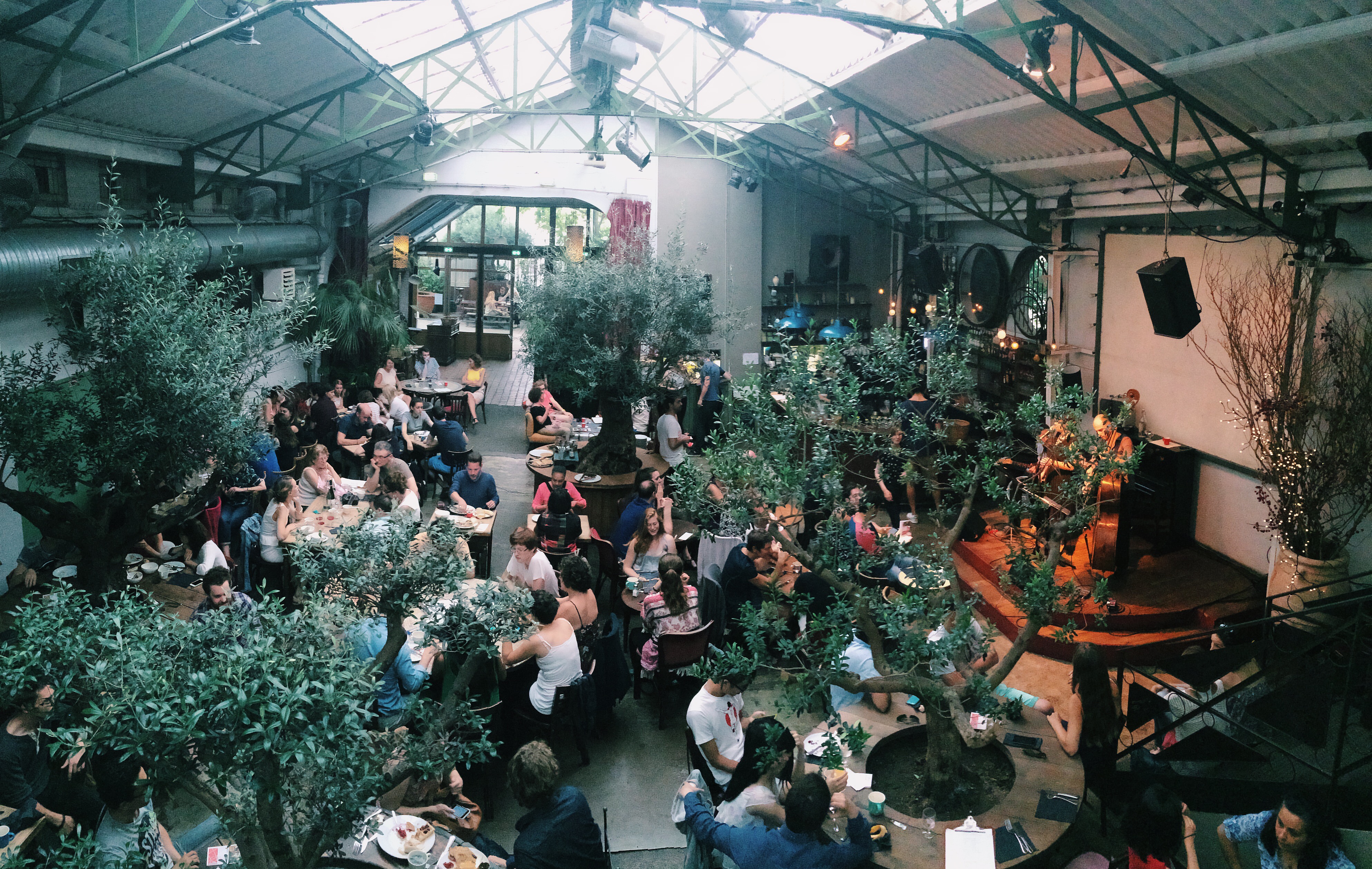
12 months, 2 weeks, and 1 day ago, I moved to Paris.
2 weeks and 1 day ago, I moved back.
Since arriving back in the United States and moving back to Nashville, there are a lot of things that have felt very different in ways that I sometimes find hard to articulate. Behind me, two blondes discuss a friend’s engagement and wedding plans, exchanging looks as they zoom in on a picture of the ring. To my left, an older man with a thick southern accent suddenly says loudly to his companions, “Yup, Ah wuz raised on bluegrass music. Ah lah-ke awl kahnds, but that ther is what Ah wuz raised on.” To my right, a college-age couple wearing brightly colored t-shirts and chacos talks about their church group. A raspy-voiced man with tattoos that cover both arms begins another sentence loaded with expletives to describe a party he went to over the weekend, and a young country singer sits a few tables down describing her direction to two men who have a social media budget in mind. As I listen to the voices that drift around me on the patio of my favorite coffee shop, there is one thing that I’m certain of: I’m not in Paris anymore.
The most frequent question I’m asked is how my transition is going, and, each time another person poses it, I look for an answer that will take less than 30 minutes for me to get out, but that also includes words more descriptive than “good.” For someone like myself, who attaches deep sentiment and feeling to a sense of place, it’s hard to find a simple answer for a question so complex as, “How is the transition going?” So I do my best to answer it in discussing how strange it is to no longer have a use for my French in my day-to-day interactions with people. I talk about the reverse culture shock that somehow continues to surprise me (don’t even get me started on how overwhelmed and surprised I constantly feel at the grocery store), and I mention a few examples of things that I had become unaccustomed to after not experiencing them often in France (i.e. Did that stranger just smile at me? He’s waving… Why is he waving?)
I can imagine perfectly what the laid-back environment that I’m now sitting in would look like in Paris. I wouldn’t be able to hear every word that the man sitting on the opposite side of the porch is saying, as the Parisians typically talk at least two decibels lower than the average American, and the porch would be “la terrasse.” The young couple next to me probably wouldn’t be talking about a church group, and likely wouldn’t be in one, and they would probably wear more fitted shirts and fairly neutral colors. Most tables would have small ashtrays, and the keys on lanyards that the Nashville customers casually place on the tabletops would be replaced by packs of cigarettes and lighters or a cellphone, and if there were keys, there certainly would be no lanyards. People would not walk in from the parking lot, but might stride up from the metro or a scooter, helmet still in hand, and they would greet their friends with a quick hello and kiss on each cheek instead of an excited squeal and a hug.
These differences, while minor in appearance, completely change the nature of how I feel my presence among the people around me. In the context of my Nashville coffee shop, I know that the person sitting next to me will smile at me 8 times out of 10, and maybe even make friendly conversation if we happen to look at each other at the same time, whereas a Parisian neighbor might not blink twice at me before looking away. I know the music might either be a light electronic blend or some sort of jazz instead of the Black Keys, and I will have to ask for “l’addition” when I’m ready to leave.
In time, I’ll stop noticing these differences. As I settle in again, the smile that has always come easily in social settings will regain its position as “polite” and “friendly” rather than “naive” or “stupid,” and I’ll go back to “getting coffee” when I want to see friends rather than “taking a glass.” It strikes me as funny that things as trivial as finding myself leaning in to greet my friends with a kiss on the cheek before catching myself and going for a hug, or having a sentence that comes to me in French before I manage to find the words in English, have become the constant reminders of the fact that I’m still very much transitioning back into my life here. But in each passing “quoi?” or “pardon” that escapes my mouth, I find the cultural and linguistic norms that I’ve become so accustomed to coming to me as instinct, and I am comforted in the thought that these little slips show that the version of myself that I have gotten to know over the past year is not soon to be lost.
 The Transition Artist
Looking forward to reading your latest entry and welcome home! Home must have many
images for you when you say that word.