Someone knocked on the door. “Uh, Linet, someone’s at the door!” I called out, unsure if I should answer it. A face popped into view through the window next to the metal door, and Dorcas’ eyes peered in. Her short hair, cropped close to her head, bobbed as she nodded in greeting. Though I had only seen her a few times, I would recognize Dorcas anywhere. The lines that framed her deep, dark, somewhat clouded eyes held stories I couldn’t even imagine, paired with the kind, gap-toothed smile that sometimes struggled to reach her eyes made up a face I knew I wanted to keep seeing. Recognizing her, I smiled and waved, and got up to answer the door.
“Mzuri! Fine, fine! Karibu!” she was already saying as she walked in the door. She took my hand in hers, as she always did, and held it as she hugged me, not letting go even once we began talking. We chatted about the red dirt that is forever stuck to our shoes after we walk around in the slum, as she removed her shoes by the front door, and she told me about her trip to buy the strong smelling “small fish” that she carried in an old bag at her side. I nodded and motioned for her to come in and sit down in my host family’s living room.
“Are you looking for Monikah or Peter?” I asked. “They’re not home from work yet, but I might be able to help you!” I assumed that she had come to ask a question or get something from one of them. Dorcas was an active member of the HIV/AIDS support group that my host parents coordinated, and a close family friend, so I guessed that her visit might be related to an upcoming group meeting.
“No, no” she said, “I come to see you!”
I had only known Dorcas about a week, the same amount of time I’d been in Kenya, and this was the third time I had seen her since we met. I was still learning about the customs and culture in Kibera, but I had already caught on to the fact that impromptu visits and hand holding were integral parts of friendships there. What I didn’t realize, though, was that I had already formed one. Though it was over a year ago, I think back on this experience all the time.
“You came to see me?” I asked, surprised.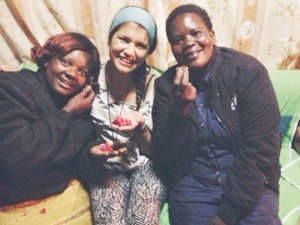
“Yes, I come to see how you do.” She responded.
She came to check on me simply because we were friends. I was floored. I had never become such close, genuine friends with someone so quickly that they would come to check on me without warning just to see how I was doing in the middle of the day. It was the easiest, most natural friendship that I had ever found myself in. I didn’t analyze whether or not we had anything in common, nor did I question whether or not we had known each other long enough for me to consider it a friendship, because she didn’t. Without question or fear of vulnerability, Dorcas just showed up on the doorstep of my home to “see I how do.”
When I talk about the “culture shock” that I experienced in both France and Kenya, I find that it is most easily described in my experiences with making friends. In my American culture, friendships are formed on the basis of mutual interests, the expectation of reciprocation in time and effort put into the relationship, and the level of comfort that people feel in each other’s presence. People are fairly easy to meet and willing to engage in conversation, and, though we can really only nurture and invest adequate time in a handful of very close friendships, we consider a large network of people our “friends.” In Kibera, and, I came to find, in much of Kenyan culture in general, there is not the same period of establishment for a friendship. Meet someone once, have a nice conversation or share something with them, and you will treat them from then on as a friend. That friend is then welcome to partake in any meal or stop by for conversation at any time. On the opposite extreme, Parisian culture mandates a much longer series of meetings and conversations before people are really considered friends. Building a friendship is a very long and intentional process, and groups of friends are often smaller, more intimate, and somewhat challenging to become a part of. There is not the same network of “acquaintances” that one doesn’t really talk to but considers friends that Americans have, nor is there the immediate acceptance factor of the Kenyans.
While, of course, these patterns and experiences of friendship can differ depending on each individual within a cultural context, my perception of making friends has been deeply linked to my understanding of other cultures. Since I have my own cultural perception of “the point of friendship,” or when the friendship has actually begun, it was both challenging and shocking at first to experience the difference in where that “point” was in my formation of friendships in Kibera and Paris.
In total, I spent one month in Kenya and came home with so many new friends that I can’t even name them all. Even people I had met once continued to call me and send me messages after I left, and I was given homemade gifts upon my departure, like a handmade rug from Dorcas that reads, “KARIBU,” or welcome in Kiswahili, a phrase that is repeated multiple times a day, each time someone enters a space. I then spent one year in Paris, and can count on two hands (without using all of my fingers) the number of friends that I made. I keep in touch with those friends weekly, if not almost daily, but it took me a long time to build those relationships.
These differences are highly reflective of the communities that I was in. In Kibera, I lived in a community-oriented culture, that values a long-term time orientation focused more on relationships and sharing than schedules and accumulation of personal wealth. As a result, “Karibu,” welcome, is repeated constantly and core values like “there is always enough to share” has new guests consistently joining us for dinner because they happened to drop by as we were eating. On the other hand, Paris, by nature of its size and large population, is a much more independent culture and places higher value on time constraints, scheduling, and personal success, hence the throngs of people pushing past one another in the metro, hard, unflinching faces that are unresponsive to a beggar’s call for money, and suspicion at any stranger’s effort to start a “casual conversation.”
Particularly when these cultural factors blur the lines, it’s hard to determine the “defining moment” of a friendship because friendships don’t work like signed contracts that begin on a set date. There is no stated agreement on when a friendship actually begins, but there is a mutual understanding of, “hey we should do this more often!” As an American who is both eager and receptive to “doing this more often,” I found that point particularly challenging to find in my struggle with language and cultural adaptation in France, while it was so easy I never even had to consider it during my time in Kenya. My inability to connect with Parisians that I met during the first few months of my study abroad could largely have been due to the fact that I was struggling with communication, but it could also be due to the fact that I expected people to want to be my friend almost immediately.
It is only now, looking back and remembering nostalgically how easily I fell into friendships in Kibera and contrasting that with my experience in Paris, that I realize how important an understanding of my own culture is, as well as a basic understanding of the one that I am entering in order to combat the challenge of culture shock. The “point of friendship” may never be easy to define, but if I have learned anything from my experiences abroad, it’s that the uncomfortable growing pains of cultural adaptation can be greatly lessened if I don’t expect another culture to be like my own.
 The Transition Artist
I know as much as I would love to live in Paris… I would be too lonely since their circle of friends is very tight and I would find myself on the outside . You and I are alike in our social needs to interact with others… I thrive on the interactions and getting to know what makes each person unique. I see a common thread between your friends in Kenya and mine in Honduras…. Maybe it’s the lack of material distractions that helps people focus on people. Great reading. Love you!