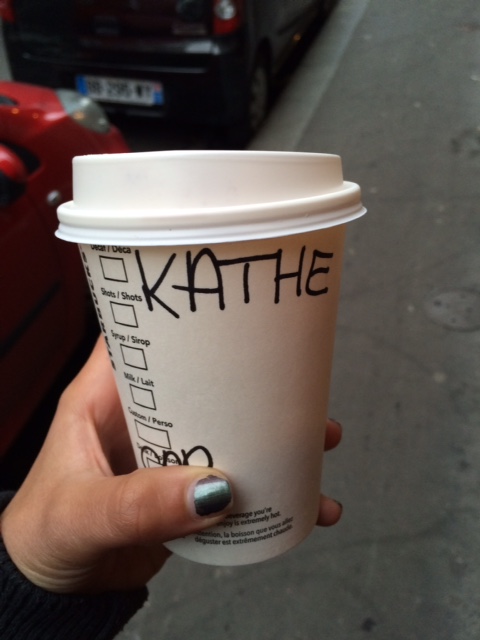
 A good number of French people have a hard time saying my name. I tell them my name is Kate, and they repeat “Kay-tuh,” almost a two syllable name, which sounds funny in comparison to my singular American syllable. The lady at Starbucks spells it “Kathe.” I say it to strangers as I kiss them on either cheek without the full introduction of, “Hi I’m Kate, so nice to meet you! What’s your name?” Instead I just lean in and utter my single syllable, because it’s understood that I’m telling them my name. I’ve learned that in French things are brief and more softly spoken, and that, though certain responses might be strange in English, they’re both expected and appropriate in French.
Living in another culture changes entirely the means by which you observe it. Ordinary conversations between parent and child become the most fascinating things I could observe. I sit on the metro and casually look around, without allowing my eyes to linger too long on any one person, as there’s not much to casually look at through the windows underground, and eye-contact with strangers in confined spaces gets weird fast. When my eyes have found nowhere suitable to settle, I typically read either a book or a magazine, whichever I happen to have in my backpack, or wind up looking at all the new pieces of dirt I’ve collected on my shoes when I lack the former.
I can’t always focus on the French words that cover the pages, and often find myself letting my ears wander while my eyes pretend to comprehend what’s on the page before me. I listen to mothers explaining at which metro stop they’ll be descending, as the child asks for the third time what it was called. I hear couples softly pondering something they’ve encountered during the day, or often arguing, though not genuinely angry, as the French are very good at that. I eavesdrop on the conversation of high schoolers coming home, who repeat “carrement” (“totally”), “en gros” (“basically”), and “bon, bref” (“yeah, well anyway”) like they are more than simple connectors. The words I listen to the most, however, are those of the children, who haven’t yet learned that it’s against the social norm to speak at any decibel louder than a soft murmur in the enclosed space. I prefer to listen to them anyway, because I relate to them.
As I hear the small grammatical mistakes made by the children on the metro, I chuckle a little to myself. I hear words used in the masculine instead of the feminine. I hear a verb that isn’t conjugated. I hear the voices of little ears that haven’t yet mastered the phonetics of the French language, though it is their own. In those moments, I can easily put myself in the shoes of the child because every single day that I speak a language that isn’t my own, I am that child. I talk louder than is socially appropriate for the French. I use words that don’t actually make any sense, misconjugate my verbs, and often pronounce something wrong, inevitably causing the French native listener to laugh. The children do all of these things, and receive very similar corrections, but they don’t stop talking. In the face of these things that I often feel embarrassed by, they don’t even flinch.
I’m amused when I understand the mistakes of these children, and even more impressed with myself when I fully understand the conversations taking place around me. Someone answers the phone, and I wonder how they make hello sound so different, as they use the same phrases I’ve heard a million times. “Oui, oui j’arrive,” (“yes, yes I’m coming”), “Non, t’inquiète,” (“No, don’t worry”), “Ok on se tient au courant, je t’embrasse” (“Okay we’ll keep each other updated, love you (or “I kiss you,” literally)”), they say into the phone. I glance up to watch people look at each other and I listen to how they respond to each other, and I learn what’s expected of me, just as those children do. In listening to and watching all of these exchanges, I’ve become a student of both language and culture. One doesn’t just adopt a language and new sense of phonetics in learning a language at its origin, one learns a new sense of self. Being like a child, still learning and understanding with my almost two syllable name has left me with more than just a new identity, but a new understanding of place and self.
 The Transition Artist
What a nice visit your journal provided today. Thank you for the very real glimpses into your inner thoughts as you absorb everything around you.