After having lunch at Diner Bedford, a cozy, American inspired diner in the Marais, I strolled back through the 3rd arrondissement towards the 1st to get to Anticafe, my favorite study spot. As I traversed the streets to make my way towards the 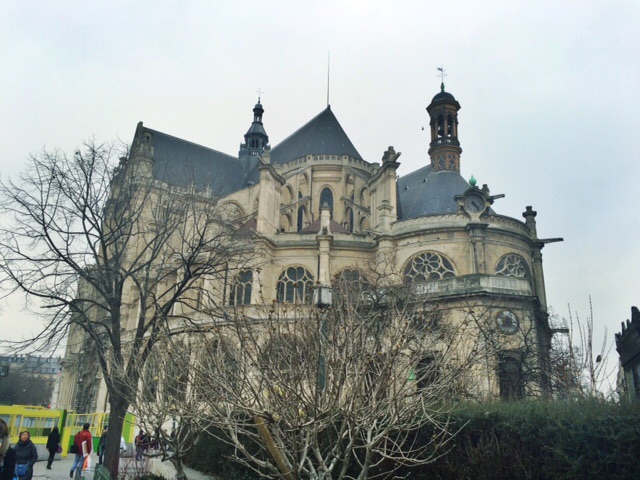 Louvre, I passed Centre Pompidou, turned down Rue Rambuteau, and continued on towards Chatelet Les Halles. I walked past the massive construction site that surrounds Les Halles, a mall and massive metro station that has been in a renovation process since before I moved to Paris. About 100 meters ahead of me sat Eglise Saint Eustache, the big church across from the Nelson Mandela park. As many times as I’ve passed this same church before, something about seeing the strong, bold architecture looming ahead of me made me pause.
The church is impossible for me to miss on my walks to and from my apartment to school. I pass it almost every day as I hustle down the street right behind the church. Rue Montorgeuil is a large pedestrian center lined with fromageries (cheese shops), boulangeries, little cafés, florists, and small produce stores. This pedestrian area, as well as the nearby Rue Saint Denis, is reminiscent of what the area used to be like, covered in modern versions of small vendors. Les Halles has been depicted in a lot of 19th century French art at its peak as a trading hub. Vendors sat outside with their wares and produce, dragging carts by hand and toting live chickens in crates, loudly bargaining and exchanging goods. In paintings that now hang in Parisian art museums like Le Petit Palais, ordinary, working class people of the period can be seen crowding Les Halles, going about their daily business, as Eglise Saint Eustache stands proudly over them.
People nowadays roam the surrounding streets, like Montorgeuil, like cattle, occasionally getting stopped by somebody with a clipboard who wants money or a signature on a petition (but every street-smart Parisian knows to look busier or more hurried than usual as soon as they approach those people loitering in red or green puffy jackets). Vendors offer samples of pizza and falafel. Couples and small groups of friends sit outside at cafés, conversing and smoking their cigarettes as they sip tiny espressos after a meal.
The people that now fill the area live lives that look entirely different from the working class Parisians that used to do their commerce right below the church, but the culture hasn’t died. Store fronts have replaced vendors with their carts, but the occasional shouts of invitation to sample and buy products still tickle the ears of the passersby. Instead of a large trading hub, there are now streets packed with little stores spanning from Les Halles the mall (filled with popular stores like H&M, fnac, and Zara, as well as a movie theater) to Centre Pompidou.
So as I paused right at the corner of these store-lined streets, to one side of me sat this massive shopping center, undergoing construction. Further ahead, the Jardins Nelson Mandela, where young people can be found listening to music and drinking or smoking in groups in the evenings. Directly across, the church. I paused to note all of these things and realized what kind of history and evolution this church has seen.
Eglise Saint Eustache is more than an architectural intrigue, as it is a blend of Gothic, Renaissance, and Baroque architecture, an interesting fusion that is telling of its 19th century reconstruction. It’s also a site around which people have been gathering and slowly evolving for a few centuries. This church has remained unchanged in an area of constant change, and as I paused to look at it, I recognized how perfect a reflection of Paris it is.
Though the city itself is modern and has become one of the fashion, art, and business capitals of the world, it is also a historic hub that allows certain elements to remain unchanged. At a weekly tea party held at Shakespeare and Co. I attended yesterday, Pamelis, an older, Welsh woman who runs the event, said between introductions and poetry readings that, “Europe has become a museum.” And she’s right. This place that now I live in is so chalk full of buildings and art that reflect so much human history that all it takes to see a vision of the past is to pause and look around.
 The Transition Artist