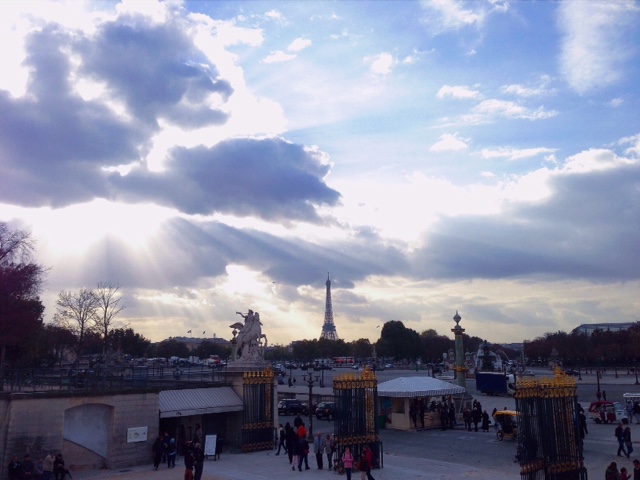
There are certain things I do wrong while I’m studying abroad. I look at my pocket map while I’m walking, and have been known to stop on a dime when I realize I’m going the wrong way, subsequently causing a train wreck of pissed off Parisians to run into me. I’ve stepped on plenty of toes in my high heeled booties on the metro. And I’ve been letting it slide when someone gives me the easy out of, “I want to practice my English,” and chatting away in my native language instead of insisting on French like I probably should.
Okay so you get it. I do some things wrong. But this past week I’ve done a pretty good amount of things right.
The other day I pulled a classic wrong move, and somehow thought the immigration museum I was supposed to be visiting for my global competence class was just a hop skip and a jump away, across from Père Lachaise cemetery, near where my friend Mamie lives. I decided to make a morning of it, met up with Mamie, stopped for a café crème and pastries and was on my merry way. Which was wonderful until I realized my merry way was the wrong way, and that we arrived right on time to an empty building, only to find that the actual museum was only actually a 10 minute walk from my apartment, but a 20 minute train ride from where we were… Let me just sum this up by saying that Google is not always right…
So, as a result Mamie and I were about 45 minutes late to the museum visit, but made it all the same, and were so glad we did. The exhibit chronicled year by year what immigration to and from France looked like. It addressed the difficulties of these immigrants and their reasons for coming, and it demonstrated how truly difficult it is to uproot an entire life in one culture to move to a totally different one. Being a foreigner myself, I halfway understood this concept, although I didn’t move here seeking refuge or livelihood.
It was interesting seeing parallels between the building of the nation that I come from and the country that I’ve adopted for the year. More interesting was the fact that these human histories still live on if only for the fact that certain customs and cultures in France exist as a result of them, though I never learned about them in school except in a broad overview of french history in a French language class. I realized not only have I sort of living under a metaphorical cultural boulder, but that as I gradually begin to shift that rock (my perspective) aside in my classes here, I can also connect the lines of history to expression in art.
By nature of being human beings, each one of us has the deepest, unquenchable need to be known and understood. By nature of my being a creative individual, I also understand that every now and then there is a certain means of connection and sharing that can only take place in art. So I decided to delve into this idea more, skip my french class in that afternoon, and explore my beautiful city to understand its people better.
I stopped by my apartment to make lunch and drop off my bag, and then promptly hopped onto the next train to the Tuileries. As if the gardens themselves weren’t wonderful enough, flanked by the Louvre and the Musee d’Orsay, inside there are two wonderful museums that hold impressionism (at Orangerie) and film and photography (at Jeu de Paumes). I can’t even put into words how much I love art museums, particularly of the impressionist variety. That being said, the Orangerie was an absolute dream. On the first floor of this museum, there are huge, curved canvases, spanning the entire length and width of the wall, of Monet’s Nympheas. These paintings of the pond in Monet’s garden are some of his most famous works, and having visited his home and garden in Giverny earlier this semester made seeing the massive works so much more incredible.
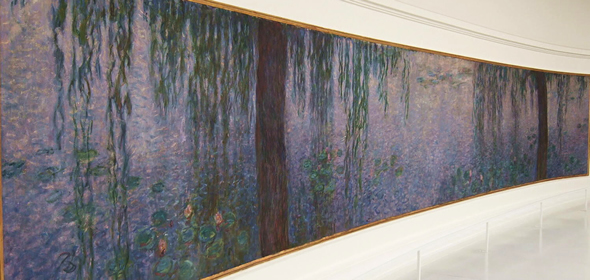
Monet is one of the most notable figures in the impressionist movement, mainly because he exemplified the idea of taking a literal impression of a moment, and using color and layering to capture the essence of that exact moment. I look at his paintings and not only see the light he saw, but feel with him what he felt as he painted, completely captivated by the color and quick, rapid brushstrokes he uses. A quote at the museum said of Monet’s work,
“Monet n’avait d’autre ambition que de rendre comte de la nature. Mais il portait sur toute chose le regard d’un artiste supérieur, sensible à la secrète poésie du réel et sachant l’exprimer dans un langage inédit.”
In English: Monet’s only ambition was to give an account of nature. But with everything, he maintained the vision of a superior artist, sensitive to the secret poetry of the “real,” knowing how to draw it forth with his own special language.
In this translation I had to change some of the wording because we wouldn’t say it the same way, but the poetry of his work reflected in the poetry of this statement is so incredible. The French language often reflects a French way of thinking, and I walked through the museum, thinking in French in order to try to connect with the works of this French painter I admire so much, and the works transformed before my eyes. Color was Monet’s means of expression, and as the massive works displayed themselves before me, I stepped closer and looked at the layers and brushstrokes, only backing up to look at these pieces in cohesion, entirely wrapped up in its beauty.
He layered. He layered again, and then he re-layered. The water was the focal point of the pieces, and in it he saw everything. The sky is reflected, the trees cast shadows, the lily pads float and drift and create ripples and shadows of their own. He doesn’t check his watch, but he knows exactly what time it is. He paints what the water sounds like as it laps against the land. He paints the sounds of peace, the holy sounds of nature working in cohesion. He doesn’t leave a single detail unattended, yet he’s not clear. It’s the most specific abstraction, because he doesn’t have to paint the bug on the tree or the bud of the flower for us to know what we’re seeing. He paints the moment. He captures the essence. He sees what’s there and in a split second it’s over. It is the phenomenological. The every day is there, but relayed with a heightened sense. He wasn’t there, but I felt like I was watching him. He concentrates, but his mind doesn’t watch the scene before him as he works, he simply allows the colors to carry him and hold him in the exact moment that he looked out over the scene before him. He paints a moment where, for a minute, everything felt right and he floated. And so we too float.
I spent roughly an hour just observing, reflecting, and admiring the facets of Monet’s Nympheas before moving downstairs to see another collection of impressionist painters, and the incredible gallery of Emile Bernard that’s on display right now. Although each style of painting is different, each artist evokes the same ideas. When sitting down to create something, what does one focus on? There were paintings of killed foul, ready to be prepared for a dinner. Paintings of landscapes, of churches, of people, and of the interior of houses lined the walls, and I saw the lives of these people. They painted not what would be the most interesting and exciting, but what they saw every day. They painted the people they loved, the people they thought were beautiful, and the average. Looking at these paintings made me feel like I was looking into the eyes of the painter, the part where the soul lives, and going with them on the journey of questioning and evaluating that is life. I was at once connected and disconnected, but it helped me understand many of the things that I wonder about each day as I try to adapt further into this culture.
Clearly, I could write pages upon pages more of reflection about the art that I saw this past week. I visited the Jeu de Paumes right after the Orangerie, saw the movie Shirley (a film that brings art pieces to life), then visited the Hokusai exhibit at the Grand Palais, and managed to get into an art event on the Champs-Elysées called “Art Elysées” where a multitude of Parisian art galleries are currently set up with some of their best pieces. If I try to describe how I felt at each one of these events individually, I’ll never finish writing this post, but to summarize: Art is the key to culture and exposes the soul. Look at artwork and you’ll see the history of a person, their feelings, their attitudes, and their perspective.
I don’t do it all right, and I’m not perfectly assimilated into Parisian culture, but by exploring the nature of the people here, I feel just the tiniest step closer to understanding.
 The Transition Artist