Overwhelmingly good. That’s the short version of what I’ve been telling people when they ask how my day was. The truth is, the short version is bland and shares nothing.
We got an early start this morning, meeting to leave at 8am, and made the 2 hour trek to Adama (also known as Nazaret) where our Ellilta Women at Risk project is located. Today was the project’s 10 year anniversary, and getting to visit on this occasion was both an honor and a pleasure. I hopped into the van for the drive over expecting to drive to a tiny little town not far away to see scarf looms or work training centers when I arrived. What I actually got was vastly more interesting, and completely blew away my expectations.
As we drove (drove being used loosely here..) out of town, we hit traffic and sat in gridlock, moving at a snails pace for about 30 minutes. Addis has some pretty bad traffic in general, primarily due to the fact that there seem to be absolutely no real traffic laws here.. There are no lanes, there’s no such thing as using a blinker, turns are executed on an I’m-expecting-you-to-stop-even-though-you-might-t-bone-me basis, there are no lights, and (traffic inducer of all traffic inducers) pedestrians wander freely, weaving in and around cars as though there’s no possibility that they could get hit. Somehow this works out okay. I have yet to see an accident in the time I’ve been here, so I guess everybody knows what they’re doing. The only problem is that when you’re going somewhere, what should take 20 minutes get somewhere can take 2 hours, and what should take 2 hours could take 3. It’s all relative, we’re running on African time (i.e. schedules are irrelevant).
So here we are sitting in traffic on the outskirts of town, drowning in the smell of exhaust with the open windows, people watching (because there’s not much else to do), and I found myself loving it. I quite literally watched all walks of life roam the streets. Mothers with babies tied to their backs in scarves (something I’ve found the Africans have absolutely mastered) headed out to the markets. Men in dirty pants and ripped t-shirts walking to their construction sites. Teenage boys shuffling along in the remnants of their shoes, prodding along a herd of goats. Random donkeys, who appeared to have been sent by someone from somewhere, roaming down the street at their own liberty, with no apparent owner guiding them to their end destination. And children in uniforms giggling together and walking to school. So I sat and watched them all start their days and go about their lives as usual from behind a pane of glass and tried to put myself in their places.
The only people I found myself identifying with, though, were the schoolchildren. I watched them skipping and playing as they headed to school and remembered being in their places. To be a kid is effortless. Sure, their childhood may look a lot different than mine did, but children are children no matter what country you’re in. They don’t yet know that we are different, and I love and identify with them because they don’t look at me and see a dollar sign or an outsider just yet (which, by the way, many people do). They see people, they have their friends, and they’re happy because they know nothing different than the life they live. I couldn’t help but wish I could freeze them right where they were, so that the world couldn’t start putting its weight on them just yet. But eventually life as usual carried on, and we left the children behind us to carry on with their days and grow up.
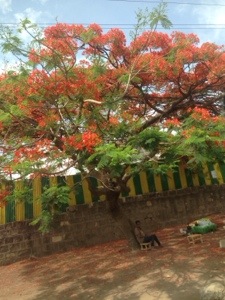
When we finally made it to Adama the scenery drastically changed, and was far different than the views I’ve gotten used to. Addis is a fairly black and white city, in terms of the fact that one minute the sidewalk is covered in businesses and is every picture of an urban city, and the next you’re driving past a side alley that turns into a rural-looking slum covered in shacks, goats, and some sort of wolf/dog/coyote street animal. Adama is fairly different, though. First of all, it’s much bigger than I expected, and, second, it’s much more of a gray scale. The city is surrounded by a rural population that gradually begins to look more urban and touristy the closer in to the heart you get. It was really interesting and actually quite beautiful. Trees called “flamboyants” lined the streets and looked exactly as the name implied.
When we finally pulled up to Ellilta, though, the real magic happened. We were met by Cherry (see previous posts for details on her and her ministry), and walked into a room full of the Ellilta women. We were first given the opportunity to watch their 10th anniversary celebration, where they thanked their supporters (us included) and a few women gave testimonies of the changes and impacts Ellilta has made on their lives. Later in the afternoon, we joined them for a worship service of celebration. It. Was. Beautiful.
Before the service started, Cherry explained that there’s a certain type of dance that’s saved especially for religious ceremonies, in which the dancer bends their torso forward opening their hands out in front of them as though they’re receiving a bundle in their arms, and moves their body side to side and up and down. She also made a slideshow of the words they would be singing in Amharic so that we could follow along in English. To be honest, though, once the service started, I didn’t even care what the words were in English, nor could I pull my eyes away from the worship before me.
The group (the elders and social workers of Ellilta) filed in singing. They sang with lilting voices, repeating the same words over and over so it almost sounded like a musical version of a chant. Everyone clapped along, some people adding their own rhythm to the music by adding extra claps in between. At the end of the line came the head counselor with a big drum used only for worship, held against his body with a rope. He beat either end of the drum, making a beautiful base sound for the music. There was something really tribal and real about the sound, and I couldn’t stop smiling and almost laughing at how happy I was as I clapped along.
I’ve explained this briefly before, but the world Ellilta is used to describe a sound Ethiopians make during worship to express joy. It’s a high pitched, quickly vibrating sound that sounds (in my American context) like a Native American Indian cry. It’s beautiful and joyful and shook me to my core. As the singing and dancing picked up, the room filled with elliltas. I can’t explain what happened as this combination of joyful worship and even more joyful sounds wrapped themselves around me, but all of a sudden I felt tears in my eyes and my heart do something that felt like backflips. I was quite literally being lifted and moved by the joy that was wrapping itself around me like a blanket and washing over the room like a sudden rush of water. I felt raw emotion bubbling up inside of me and did everything I could not to cry, but stood so moved by the experience and the need to be present in it that I couldn’t even reach for my camera.
The rest of the service was equally as beautiful, and two more women spoke and told of God’s lifting up in their lives and encouraged the other women to be strong. One read from 2 Timothy and encouraged the room not to let their light go out, but to burn brighter and stronger no matter how dark the past was. Finally, a fervent prayer was said over the staff of this Ellilta location (the other is in Addis) and a worship drum was passed on to them for their own use in future services. The service was ended in more song and dance, and I’ve spent the rest of the day coming down from that high.
Unfortunately, I can only detail these experiences in long winded stories with detailed adjectives, and none of my words will ever do justice to what I was able to experience today. However, what I can say that is in any way definite is that the love and joy of God is infinite. There is no one expression of this beauty that will ever do full justice to the capacity of that love and joyfulness that I know of. I’ve experienced worship in many different ways, and realized that just when I thought I knew what it felt like to have my heart fit to explode with pure joy, I can still be shown something deeper. Knowing there is a love that infinite is one of the most precious and wonderful things I could ever imagine, and I hope that, even though I can’t fully share what I experienced with those of you reading this, you get to know that kind of love too.
 The Transition Artist